Saturday, November 21, 2015

Pleiades Ribbon mic transformers

A great ribbon microphone transformer can be wound on an extremely high inductance index nanoperm tape wound core by Magnetec.


The very few turns needed would result in an excellent step up transformer with least noise figure.


Silver wire could be used for the 2 windings.

Pleiades Mixing Console

It would be great to make a passive mixing console with just summing transformers (hybrid transformers) made with Magnetec's nanocrystalinne tape wound toroidal cores.


The best way to add signals with minimum loss is with spliter transformers connected the other way round.


Signal 1 is connected to upper side of primary winding. Signal 2 is connected to lower side of primary, Center tap of primary is connected through canceling resistor to ground. Signal (1+2) is received from secondary in all its pristine glory.


This is how Hollywood did it and more information can be found in earlier euroelectron posts. Many signals can be combined to one.

Wednesday, November 18, 2015

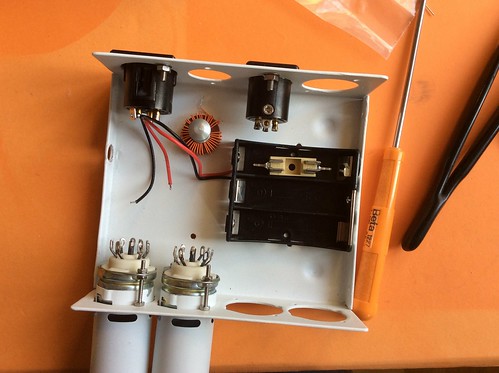
Pleiades 2 stage EF183 battery microphone preamplifier with positive biasing resistor from anode to grid and Magnetec core Pleiades bass proximity compensating input transformer, (under construction)


Pleiades 2 stage battery EF183 electron tube microphone preamplifier under construction


2 li-ion 3.7V batteries will be used in series for series heaters (each tube heater deliberately at 3.7V, see older posts) and anode supply 7.4V.


Schematic and completed prototype of 1 stage EF183 battery pre preamplifier is given on following posts.


Pleiades public domain dedication


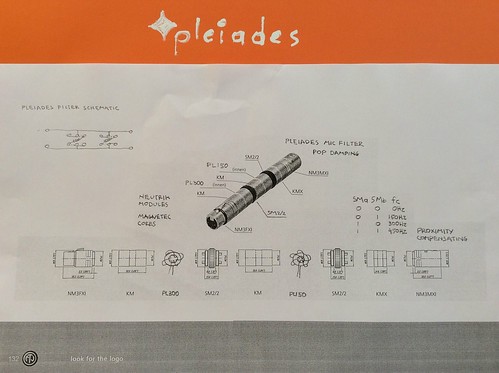
Pleiades 4 focus points, microphone proximity compensating and pop filter schematic with Magnetec cores and Neutrik modules

Pleiades 4 focus points microphone proximity compensating and pop damping filter using Neutrik modules and Magnetec nanocrystalinne cores

4 focus points. (optimum bass proximity compensated distances from sound source to microphone)


For 16 points use 4 cascaded Pleiades filters.


Pop blast filtering due to electromagnetic damping.


Passes phantom power as inductors are in parallel with signal.


Gentle 6dB per octave low cut filtering (1st order slope as filter consists of the mic's output impedance in series with the Pleiades filter's  inductance) for overall flat frequency response compensating for the increase of bass content when directional mics at used at close distance.


Relatively few turns needed due to the extremely high inductance index of nanocrystalinne Magnetec cores, Magnetec 073 tape wound nanoperm core or equivalent. Typical number of turns is 40 - 100.


Ease of construction due to the amazing Neutrik modules with switch.


Other variations can include impedance matching transformers. Step up transformers with switched primary in order to low cut and at the same time make up gain.(decreasing primary turns increases cutoff while increases step up ratio).


Impedance matching transformers with deliberate low primary inductance to compensate for excessive bass boost of vocals at close mic distance due to proximity effect. Ambient low frequency noise noise is canceled.


Pop filtering due to electromagnetic damping. (the lower the frequency the lower the impedance of the inductor in parallel thereby converting voice coil movement to heat.


Neutrik connectors and Magnetec cores are the most beautiful worldwide.


Pleiades public domain dedication.


More details:


Directional (unidirectional cardioid) microphones boost bass frequencies progressively below 1 KHz when a singer is closer than an inch to a microphone, the usual case.


The amount of boost can easily be heard experimentally (in practice) or seen in any directional microphone data sheet Shure for example. This can prove an advantage as we shall later see.


The low cut filter of most consoles is at 100Hz giving erroneous results and we are all familiar with the unnatural bass heavy voice when a singer is close to the microphone for  avoiding acoustic feedback. The amount of bass boost as seen on curves is inversely proportional to the mic source distance and can as high as +15dB at 200Hz.


The Pleiades filters intends to give a flat overall response at the usual different close preferred microphone  mouth distances. It may be thought to act analogous to a macro camera focusing lens for very near objects.


Added advantage is a very high signal to noise ratio capturing the detail of the faintest voice even in high ambient noise environments. (Bass environment content is dramatically reduced while voice remains natural).


The Pleiades filter consists of just an inductor in parallel with the mic output signal. This gives the added advantage of electromagnetically damping the mic membrane and dramatically reducing pop and wind noise.


Magnetec makes possibly the best noncrystalline magnetic cores and Neutrik the best modular connectors. It seems natural to combine these elements to make a state of the art variable Pleiades filter.


Sunday, November 15, 2015

Using Neutrik adapters, modules for Pleiades microphone filters and transformers

The Neutrik modules would be excellent for assembling a variable proximity compensating filter, cascading many Pleiades filters and switching with binary code combinations. Similarly for variable primary Pleiades microphone transformers.


The D shape adaptors would be great to accommodate large Nanocrystalinne tape wound cores for microphone matching transformers and moving coil cartridge matching transformers (passive pre preamplifier).


Neutrik connectors are the most beautiful worldwide.

Friday, November 6, 2015

Can a Pleiades Electra headphones tube amp be made with just one PCC88 or ECC88?


Preferably PCC88.


It may be possible if positive grid bias is used to increase anode current and gm.


The higher battery voltage source will supply and under heat if needed heaters and also supply anodes directly through the high impedance headphone windings.


Oops, the heater is 7V which is not very high. Perhaps 2 PCC88 can be used heaters in series. This will allow under heated operation (which seems desirable) at 12V supply. 12V for anodes should be great as a doubling of voltage quadruples power, P=(V squared) / 2.


The 2 paralleled triodes for each channel will also reduce output impedance to half .

Can a tube mic pre pre amp be made that operates on 1.3 Volts?


An electrometer tube can be used as shown in an earlier entry.


But can a PCxxx or PFxxx type be used?


Since their heaters operate at 4V, 1.3 Volts may provide the right under heating needed for low anode voltage operation.


Positive grid bias may do the trick as well as output transformer use so that the plate (anode) can be supplied  with 1.3V which is already too low.


The trick is to find a tube that is high gm and vary gm (variable tranconductance) as they have uneven grid spacing. Pentodes are very suitable since when triode connected the 2nd grid (screen grid) acts as an anode and is very close to the cathode to attract electrons.