Wednesday, March 14, 2018

A variable input inductance microphone preamplifier input transformer


A way may be using a ring core in a variable or autotransformer arrangement


So as the moving slider(s) selects less turns the input inductance is reduced and the turns ratio is increased.


So proximity compensation is increased. As bass drops the overall gain is compensated by the increased turn ratio and the fact that the singer is closer to the microphone.


Multitap input transformer for the Pleiades V6


For example there can be 4 inputs on the Pleiades V6 but only one input transformer used.


As an example let as suppose that the octagon aluminum die cast box has on some of the sides 3 female XLR female sockets and one 1/4in input socket.


The core has 3 primary windings and each winding is connected to each balanced input.


One of the balanced inputs can be of 140mH by being connected to the 140mH input transformer winding. In fact the wire coming out of the core can be twisted and directly connected to pins live, return ie 2,3. This is useful for connecting 25Ω mics such as Grampian DP4/L or STC 4021 apple and biscuit etc. Also for connecting a Sennheiser 200Ω MD21. Or for directional microphones of about 200ohms such as AKG D112, D1000, Shure SM57 or Unidyne III, Sennheiser MD441, Electro-Voice RE15 etc when these are used for singing at a distance of a few only inch thereby compensating for the proximity and other psychoacoustic effects. See next euroelectron post on the importance of input inductance rather than impedance. Such a transformer has been tested on the V6 and these mics expect the 4021 with very good results. It is wound on the Magnetec 070 ring Nanoperm core, has a ratio of 1:10 and input inductance of 140mH. See other euroelectron posts.


The second input can be of more primary turns having for example an input inductance of 300mH. This winding would having more turns and since the secondary on this example is constant the turn ratio would be less. This winding would give a more bass extension making it suitable for example for... A Sennheiser MD211N for vocal singing. An MD21 for recording drums. 200Ω directional moving coil microphones for vocal singing at 1-2feet for example. It is important to understand that more turns gives a higher input inductance. So the impedance at low frequencies is not reduced. Therefore there is no voltage drop at the mic's terminals at low frequencies. Other possible uses are: Distant mic capture with a Gramoian GR1/L or GR2/L 25 Ω ribbon microphones for full range sound capture to listener's brain. The fact that the turn ratio of this transformer may be less than 1:7 or even less than 1:5 should not matter at all for noise considerations as the equivalent input noise resistance of the Pleiades V6 is of the order of only 2500Ω. In addition microphone loading is minimal. For example with a turn ratio of 1:5 the input impedance of the grid which is 100KΩ is transformed to 100KΩ:5:5 or 5KΩ. So a mic of 200Ω sees a 5KΩ input at the frequencies of interest. An Electro-Voice 635a can be connected for more bass than the previous terminal.


Another winding of very few turns may be connected to the 3rd XLR input. The very low inductance can be of 14mH for example. This roughly means 1000 less than the secondary which is 16H. So a turn ratio of aboit 1:33. This may be used with a low impedance ribbon microphone such as the 25Ω Grampian GR1/L or GR2//L for very close singing voice of correct frequency response to listener's brain. A full spectrum sound with great high end detail. The best value of input inductance is best decided by the application of interest and the desired result.


The other input is an unbalanced one connected to the 22nF input grid capacitor. A switch may allow the secondary to be connected in parallel. The switchable low cut may be useful for example for compensating for exagerated bass frequency perception to listener's brain when an electric bass is directly injected to the control grid circuit.


Reference:


Pleiades V6 Schematic


Specifying head microphone amplifier inputs in terms of inductance rather than impedance


Input inductance is very relevant to sound.


For example it can compensate or not for the proximity effect, Fletcher Manson brain perception curves, Voice effort curves of human voice and singing production.


How impedance varies with frequency is important.


Perhaps the best is having both specifications. Or even more. For example what is the input impedance, what is the input inductance, how does impedance vary with frequency, what is the equivalent input noise resistance etc.


As an example of the above elements. One pre preamplifier can have 3 200ohm rated inputs. One with 1 Henry input inductance for orchestral applications, one with 300mH input inductance for voice or singing. And one with 140mH for close mic singng, compensating the proximity effect etc.


Input inductance depends on the number of turns of a coil in parallel with the input signal. It may be a Pleiades filter or the primary inductance of the input transformer etc.


These considerations may be important as what matters is not flat frequency response from mic to loudspeaker. But flat frequency response from producer's brain to listener's brain.


Reference:


Flat frequency response from actor's, singer's brain to listener's brain, Sound picture recording and reproducing characteristics - Loye, Morgan - Journal of the Motion Picture Sound Engineers


Coil Design and Cinstruction Manual - B.B. Babani


Tuesday, March 13, 2018

Hello to Bulgaria, Spain, Netherlands euroelectron viewers


And to all viewers from almost anywhere in the world.


Thank you all!


Attention before dismissing microphones


It may be that what is dismissed is the preamplifier interface connection.


The dismissed mic may be a diamond.


For example:


A Grampian DP4/L may be connected to a top class Sony TC-D5 Pro transformer balanced input preamp.


Due to the very low voltage output of the 25Ω voice coil of the mic the gain at Sony may have to be turned at max. Then there is hiss. But this is not the hiss of the mic.


The sound may sound just OK but nothing really special since we cannot judge something that is almost buried in hiss. It is like finding a diamond covered with whatever making it look like something covered with mud that has to thrown away.


When a top quality low noise head amplifier is connected between the two... as we should do with a condenser capsule, for example Neumann U47...


The sound becomes a few hundred times as big. With no hiss. The Sony input level potentiometer control would need to be just at 3 out of 10 with a soft singing voice.


The sound is bass full, without bass heaviness, with excellent mid and treble detail.


If the 25ohms mic is stepped up by a transformer to say 600ohm and then feeding directly the Sony TC-D5 Pro, although it would sound louder that at 25Ω there may not be the same top class of high frequency responce due to the loading to the mic. Assuming the TC-D5 pro has an input impedance of 4Kohms, the 600ohms are loaded by 4kohms.


Whereas if a battery operated electron tube headamp is used such as the Pleiades V6 the loading is much less. Assuming a 1:10 input transformer is inside the Pleiades V6 the 25ohm voice coil is stepped up to 2.5Kohms. But the input impedance looking at the electron tube grid is 100Kohms so the loading is minimal. Also the Pleiades V6 has a very low equivalent input noise resistance meaning it is a very low noise head amp. So the turns ratio can be 1:10 even with a 25ohm microphone. A typical value of the equivalent input noise resistance may be around 2.5Kohm. Calculating from righ to left, the input transformer makes it 2500:10:10 or 25Ω, very comparable to the mic. Also the mic is loaded by 100KΩ:10:10 or only 1KΩ.


The input inductance of this particular 1:10 input transformer is only 140mH. This is a joy to wind as the Magnetec 070 ring core is wound by only 35 turns of wirewrap wire for the primaryOr input winding. This is possible as the mic is 25ohms. 25ohm and 140mH give a turnover at around 28Hz. (This is found by 25Ω:2:3.14:0.140Henries. The same low input inductance can be used for connecting to directional 200Ω mics for compensating the proximity effect. For example the AKG D1000, AKG D112, Shure Unidune III or SM57. The Sennheiser MD441 for close vocals as well as the omni MD21 can be connected. The output transformer used introduces a -3dB point at around 100Hz. It makes a very balanced flat frequency response from singer's vocal chords to listener's brain. Otherwise the sound might have been bass heavy. But it all depends on the conditions.


Signal path, setup:


Grampian DP4/L - Pleiades V6 - Sony TC-D5 Pro - Sennheiser HD580
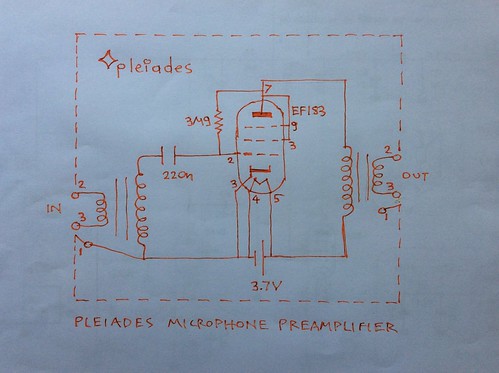

Pleiades V6 schematic


References:


Pleiades V6 Schematic


Neumann U47 Schematic


Flat frequency response from singer's vocal chords to listener's brain, Sound Picture Recording and Reproducing Characteristics - Loye, Morgan - Jkurnal of Motion Pictures Sound Engineers


The myth that dynamic or voice coil microphones do not need a head amplifier


Of course they do.


And then they send for tea most of the condensers, even the very expensive vintage ones.


The sounds jumps out, there is no hiss, all ambience detail from tens of meters away if gain is up. With a good moving coil microphone the sound is as smooth and big as it may get. Ribbon microphones too.


An example setup is:


Moving coil mic - Pleiades V6 prepreamp - a mic preamplifier


Similarly for ribbon microphones.


Other example is using just a JFET instead of an electron tube, see Pleiades K117 schematic. An output transformer would usually need to be connected too. But it works even without, just capacitor coupling. For example:


Moving coil or ribbon mic - Pleiades K117 - Telefunken V72


From the moving coil microphones the category of pressure ones have diaphragm that is acoustic resistance controlled broadband tuned near midland as directional condenser capsules should do.


So they do not have the harshness of omni condensers tuned at HF. They have the detail of condensers, but smoothness of high frequencies as the amplitude of the diaphragm must decrease with rising frequency for flat frequency response output. This is because the voltage output of moving coil mics is proportional to the velocity of the diaphragm due to the magnetic induction law.


And of course on moving coil or ribbon microphones the head amplifier can be meters away instead of having to be mounted right next the capsule.


Pleiades V6 schematic


References, bibliography:


Pleiades V6 schematic


BBC Engineering Training Manual: Microphones
http://www.bbceng.info/additions/2016/BBC%20Engineering%20Training%20Manual%20-%20Microphones%20(WW).pdf


Microphones - Borwick


Microphones - Boré, Peus - Neumann - PDF


Monday, March 12, 2018

How Steve Booker produced Stepping Stone - Duffy


Extracts from a  hitquarters interview?


"I think you hear great music that has come from people who have just kept their heads down and just work incredibly hard. And within Logic you can develop a sound where you don't need to do anything else."


"I did Duffy's record on my laptop. It was only after I got paid for her record I could afford to buy a proper computer really".


Reference:


http://aimeeduffy.blogspot.gr/2010/03/interview-with-steve-booker.html


Unfortunately the link does not operate anymore
http://www.hitquarters.com/cgi-sys/suspendedpage.cgi?page=intrview/opar/intrview_Steve_Booker_Interview.html