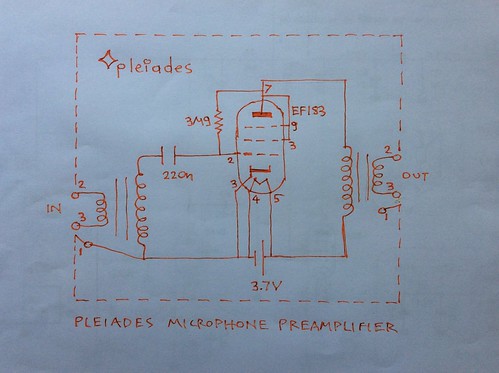
In summary the same low voltage battery supplies heaters, grid and anode circuit.
The heaters are deliberately supplied by lower voltage to minimize temperature emission effects and noise in other electrodes and match space charge saturation (no shot effect condition) for the low anode voltage.[references]
The anode is deliberately supplied by a low voltage so that instatenious peak limiting (increasing average loudness) [Hamm] may be occur without the need to sing too loudly to the microphone. A low anode voltage makes possible the use of a low cathode temperature for space charge saturation and no shot noise effect. Also dramatically reduces secondary electron emission, positive ion generation by collisions etc.
Even without connecting anything but a heater voltage to an electron tube the grid potential can be measured to be many hundred millivolts negative with repect to cathode. This cuts off electron current at low anode voltage supply. The grid is deliberately pulled up by a typically 6MΩ resistor from anode to grid. It is still negative but much closer to 0V wrt cathode. This makes possible the use of very low anode voltage and heater voltage while the anode current is relatively high, anode impedance is low, transconductance is high, gain is relatively high and noise low. While the grid resistor or Pleiades bias resistor can be connected to Vb it was found by microphone to headphone listening tests in real time that the sound quality is even better when it is connected to the anode. This type of bias is called Pleiades or anode bias. The effect of the Pleiades bias is also reducing the input impedance to a typical value of 100KΩ.
The idea of not supplying the grid from a negative source comes from Hliana who very seriously insisted on the electrons be biased by a positive supply so that they can be free.
It can be seen on the paper by Armstrong that the inclusion of a grid in an electron tube, even when it is unconnected, results in a great reduction of the anode current.
The Pleiades bias compensates this, freeing electrons. It is possible that at such low temperature, low electric field operating conditions an electron tube tends to the ideal low noise operation. [references]
References:
A study of Noise in Vacuum Tubes and attached circuits - F. B. Llewellyn - Bell Telephone Laboratories, N.Y.
Fluctuation Noise in Vacuum tubes - G. L. Pearson
On preserving transconductance of electron tubes at an anode potential as low as 3 volts - euroelectron
Operating features of the Audion - E. H. Armstrong
Tubes vs Transistors is there an audible difference? - Russel O. Hamm - JAES

No comments:
Post a Comment