It may be possible. The idea of using an electrometer electron tube comes from Sean Davies, disc cutting equipment realization specialist and not only. He had mentioned his use of electrometer tubes as a condenser microphone front end amplifier.
Can the CV2268'operate satisfactorily on the Pleiades V6 head amplifier?
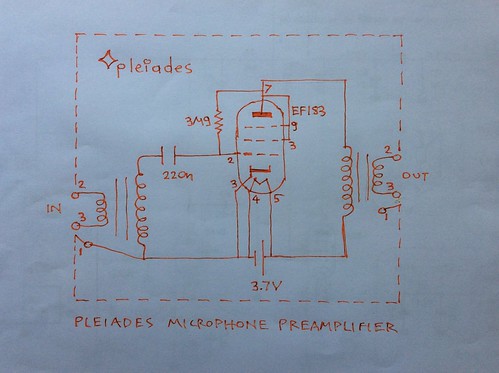
On the above schematic Cc is usually 22nF.
The CV2269 can be powered using a battery of 1.2V. (A fuse in series should always be used for safety).
It is a directly heated (filament) electron tube so connection would be as on the above Pleiades V6 schematic but with no cathode as the heater is the cathode itself.
For a brief listening test using an anode resitor coupled by a capacitor to an output transformer (as on the Neumann U47 circuit), see the day before yesterday's post.
http://euroelectron.blogspot.com/2018/07/a-one-tube-microphone-headamp-operating.html
When a transformer is directly connected to anode there is almost no voltage drop so more voltage will appear to the anode.
No such connection to a transformers has been done yet. But today the anode was connected directly to Vb in order to investigate or measure what is the anode current.
Using a small breadboard a CV2269 was powered and Pleiades biased with an 8.2MΩ resistor.
A healthy 9μA current was measured.
When connecting a 1.8MΩ Pleiades bias resistor as is done on the Nuvistor 7586 when operated at Va=1.3V the anode current should increase.
It seems best to adjust the Pleiades bias Rag resistor while listening. (Attention to ears and hearing when using headphones, all precautions must be followed, use of suitable monitoring headphone limiter etc.
How would the same circuit sound with a vintage 1H4 triode? The idea of using an 1H4 comes from a Glass Audio magazine article on battery tubes.
How would it sound with a Nuvistor 2DV4, 2DS4, 2CW4?
The idea of using an EF183 (so far the electron tube with the most anode current and gain at Va<4v br="" comes="" from="" mpouriotis="" mr.="" yannis="">
Power consumption:
The electrometer electron tube has a ridiculously low heater current of 13mA.
The 1H4 underheated should be about 47mA.
The Nuvistors underheated should be about 300-350mA?
Underheating, should increase the signal to noise ratio especially at low anode potential, see previous posts.
Using the CV2269 the gain will be small, there will be microphony ringing, the output transformer inductance should be large to preserve bass. With a lower Rag thing may be better as the anode internal resistance is lowered. Even if there is low cut this can be a blessing in disguise as it would immediately compensate for the proximity bass boost effect, for example on directional microphones. See day before yesterday's post on using the Shure Unidyne III with the CV2269.
An advantage is having the electron tube processing characteristics at only 13mA, 1.2V in a small box.
Further reading:
The Pleiades Bias
Tubes vs Transistors (vs op amps), is there an audible difference? - Russel O. Hamm - JAES
Operating Features of the Audion - E. H. Armstrong

No comments:
Post a Comment