This is on the following setup:
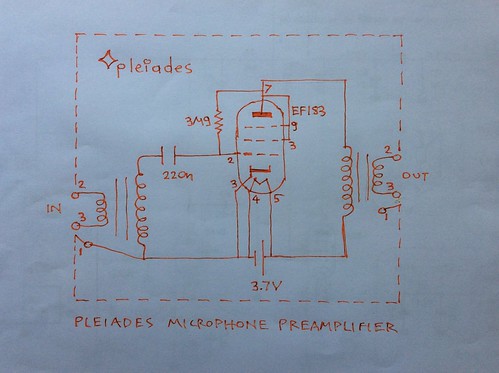
Electron tube is the Nuvistor 7586, Cc=22nF, Rag=6MΩ or 1.8MΩ, Rh=10Ω (series heater R)
Setup, signal path:
Male singing voice - Shure Unidyne III - Pleiades (130Ω,40mH) filter - Pleiades V6 - Sony TC-D5 Pro - Sennheiser HD580
When the Pleiades V6 is included in the circuit the sound becomes many times bigger when Va is 4V. The sound has full body at about 8in.
When Va is decreased the sound becomes thinner so to restore fullness the singer has to aproach the microphone. At Va=1.3V the singer must be at 1-2in. So even if the head amp gain is decreased it is compensated by closer distance. Noise performance (hiss) seem to start to deteriorate below 1.3V. This is with a Pleiades bias resistor of 1.8Ω. It may be better with a lower value. More investigation is needed. The Sennehsier MD211 seems more suitable for this setup. Perhaps a different value of Pleiades (R,L) filter is needed for the Unidyne III. Much of the Pet Sounds sound is there though. Brian Wilson can be read to have used Unidyne III for his vocals on Pet Sounds - Beach Boys. If fact the Pleiades low cut filter can be omitted as a low Va also results to decrease to bass decrease.
The change in bass cutoff frequency is expected as by reducing the anode voltage the anode current is reduced therefore the anode internal resistance therefore a greater voltage drop across the output transformer's primary at low frequency. Therefore LF drop at the output of the secondary of the transformer.
http://euroelectron.blogspot.com/2018/07/approaching-pet-sounds-brian-wilson.html
General reference: Communication Engineering - Everitt, chapter XV, class A amplifiers

No comments:
Post a Comment