It sounds strange but it is not. It becomes a passive amplifier. Not as big or loud as when the Nuvistor 7586 is in the circuit but a very interesting sound.
Looking at the schematic....
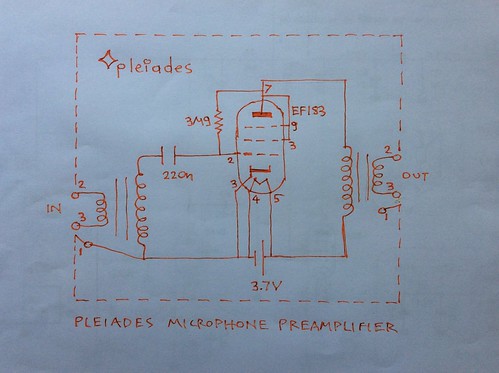
First removing the batteries.
Then connecting a link between the 2 terminals of the Pleiades high Megohm resitor.
There ismalwaysnsime sound out of the Pleiades V6 before connecting heater voltage. Very very faint. By connecting the link the coupling capacitormjoinsntye 2 transformers.
Amazing sound on Unidyne III. The MD211 sounded a bit bass heavy.
Signal path setup:
Mic - Pleiades (130Ω,40mH) brain perception EQ - Pleiadss V6 with batteries removed and 6ΜΩ biasing resistors made to a short circuit - Sony TC-D5 Pro - Sennheiser HD580
Attention to phase, now the setup phase inverts. So by the use of an phases inverting adaptor phase is restored.
The Unidyne sounded already better. Further investigation showed that it was already wired out of phase.
The sound is great and louder than connecting any of the mics straight to Sony TC-D5 Pro.
Of course it is not as loud as when the 7586 Nuvistor electron tube is powered even by 1.5V at the anode (see yesterday's post). Direct comparisons between electron tube or not have not been made yet.
It may be interesting to included an electron tube bypass switch on the Pleiades V6 letting only the transformers do their flat brain perception job. The switch would be tricky as the anode supply would have to be removed at the same time.
See also today's post on using the cathode, grid of an electron tube as an internaly biased diode linking the 2 transformers. And perhaps adding gentle overload characteristics.

No comments:
Post a Comment