Yes tubes may need 500V at the anode if the electron tube is a 300B and the objective is a class A power amplifier.
But the first stage of a system or front end dictates the noise performance of the whole system. Any defect or noise at the front end will be amplified by all subsequent stages.
So the requirement is not power, not nessesarily voltage gain. It is low noise. Low noise figure.
On very low voltage output microphones such as (small magnet) ribbon microphones (eg Grampian) the use of electron tubes at very low anode voltage gives a very impressive signal to noise ratio. See older posts.
A typical schematic, the same battery powering both heaters and anode is the Pleiades V6.
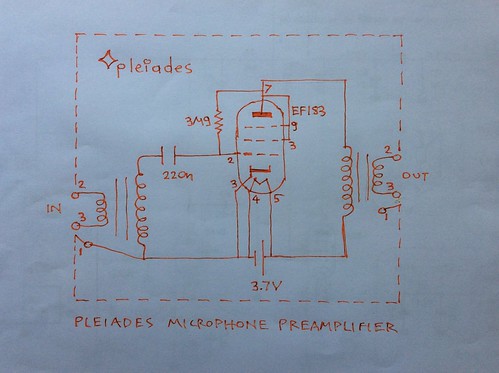
Operation at very low anode potential is made possible by the use of the Pleiades bias resitor, Rag. Normally the cathode is 700mV greater than grid due to electron velocity emission. Escaped electrons leave the cathode positive charged by the remaining protons. But then electrons are trapped in the grid cathode space as the grid is -700mV with respect to cathode. The Pleiades bias makes the grid typically -70mV so life is then very easy for the electrons. The liberated electrons can arrive to a low potential anode while amplifying the music signal in all its prestige glory and low noise.
So far possibly the lower noise was obtained at 4V anode potential for the EF183, Nuvistor 7586 electron tubes.
On recent Pleiades experiments these electron tubes were found to operate at even much less than 1.5V with a lower Pleiades bias resistor. So far a guess is that 1.2V is a safe limit.
No conclusion is yet as to whether 1.2V or even less brings a further improvement in noise figure.
Underheating ie low cathode temperature by reduced heater voltage seems to play an important role in further reducing the noise of a LNA. On previous experiments the external typically 0.5μA grid to anode current seems not to vary with the voltage suggesting no shot noise effect. The anode current varies with heater voltage but no increase in noise is observed unless the heater voltage becomes less than half the rated voltage. Usually while disconecting the heater circuit and listening (attention for ear protection), the signal to noise ratio initially increases. (See also the Neumann U47 with the VF14 cathode underheated by Georg Neumann using reduced heater voltage).
Low anode voltage (small voltage supply rails) also brings in with possibly 1 or 2 stages of amplification the desirable signal processing characteristics of electron tubes at signal peaks. The tube sound. What is the tube sound? It may be called the property of fitting something tremendous (music) to something smaller so that then operational amplifiers or A to D converters will not heavily distort by clipping. The loudness is preserved or even enhanced [Hamm]. At the same time electron tube amplifiers operating in class A (electrons flowing all the time) have possibly the least distortion on the planet near the 0 crossing point where most of the music signal lies about. And this with no feedback. Jfets and bipolar transistors operating in class A with no feedback seem to have too this property. This makes for a smooth sound and it is not the sound of electron tubes, it is the sound of nature itself.
More experiments are needed.
References:
The Pleiades Bias
On preserving the transconuctance of electron tubes at anode potential as low as 3V - euroelectron
Operating Features of the Audion - E. H. Armstrong
A Study of Noise in Vacuum Tubes and Attached Circuits - F. b. llewellyn
Tubes vs Transistor (vs op amps), is there an audible difference? - Russel O. Hamm - JAES

No comments:
Post a Comment