is that if we do not do anything the electron tube is self biased at 0 volts. So that we need to make the grid negative etc.
In fact if we do not do anything the electron tube is already negatively internaly biased at the grid. This is by the electron velocity emission. Missing emmited electrons from the cathode make the cathode positive (as many positive protons are left alone). So the cathode is positive with respect to grid or the grid negative wrt cathode.
This is very easy to demonstrate by supplying carefully (with a series fuse for safety) a heater voltage on any electron tube and measuring the voltage or potential from cathode to grid.
The value for an EF183 underheated by a supply of 4V is Vg=-700mV. (It will be much more negative if 6.3V heater voltage is applied).
When a Pleiades bias resitor from a positive source such as anode is connected to grid and the circuit is in operation the bias may become -70mV.
This makes possible the operation of the electron tube at very low anode potentials such as 4V on the microphone booster circuit below:
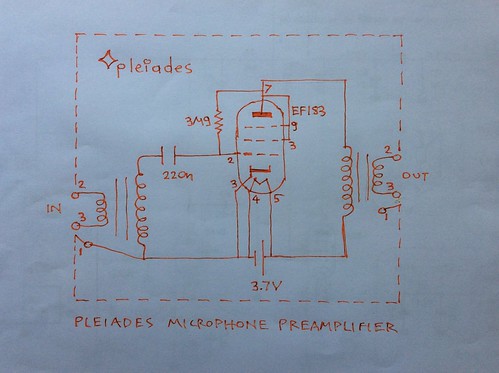
The Pleiades V6 schematic, more common values are a Pleiades bias resistor of 6MΩ, Cc=22nF, a Nuvistor 7586 can be connected too. If a direct heater electron tube is connected pin 3 (cathode) is omitted as the filament is the cathode itself.
Further reading:
The Pleiades Bias - euroelectron
On preserving transconductance of electron tubes at anode potential as low as 3 volts - euroelectron
http://euroelectron.blogspot.com/2018/07/playing-with-electrons-with-cv2269-tube.html
Operating Featuree of the Audion - E. H. Armstrong

No comments:
Post a Comment