When we apply heater voltage (always with a fuse in series to psi or battery for safety) to an electron tube, EF183 for example, the grid becomes -700mV with respect to cathode. This happens when a heater voltage of 4V is applied. If 6.3V were applied the grid bias would be even more negative.
The Pleiades bias resistor of 6MΩ from anode to grid when the anode is supplied by 4V makes (or pulls up) the grid at typically -70mV. The electron tube operates normally, see circuit below:
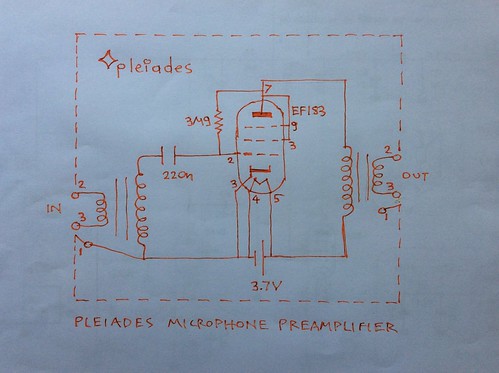
Pleiades V6 schematic. Rag is usually 6MΩ, Cc=22nF, the 7586 Nuvistor electron tube can also be used, and other electron tubes.
But suppose we wish to keep the grid potential to its internal value. Assuming this is -700mV and it does not change much by applying anode voltage (in fact it will). Where does the -700mV come from to the grid? It should be due to the emission velocities of electrons. We have a sea of electrons at room temperature. At some hundred centigrade, thermally emmited electrons from cathode leave as many protons lonely. Cathode becomes positive or grid becomes negative with respect to cathode.
Suppose we wish to keep the grid at -700mV. Then the only way to have anode current is to increase the anode voltage. (Attention to safety at any voltage).
Let's say such a potential is 40V. The electron tube should operate at open grid.
Suppose then that we wish to connect a grid resistor but without upsetting the grid potential or anode current.
Internally the cathode is 700mV more positive than the grid. In other words cathode is at 700mV, grid is at 0 volts. So externally the same thing should happen. So we connect a cathode resitor such as the potential from cathode to ground is 700mV.
Then no matter what the grid resistor from grid to ground the grid potential should remain at space potential ie -700mV with respect to cathode. Let's say we then choose a 70MΩ grid return resistor.
A way to verify we are not upsetting the grid space potential is to connect a grid resistor and see if there is no change in anode current.
Why should we need for example an 70MΩ resistor? Just in case a very high peak arrives and is rectified by driving the grid positive. The rectification effect will make the grid negative. The gain will decrease but it will stay decreased. We need a release time constant to this compressor or automatic gain control. So with the 70MΩ grid leak resistor the grid will return to space potential of -700mV.
Is this what is done on the Neumann U47, VF14 electron tube? Is this 0 grid cirrent? Or could it be than Georg Neumann was monitoring grid current and adjusting Rk and the heater voltage for min grid current. Other sources of grid cure t may be present at medium anode voltage. Or was he carefully adjusting by ear for best sound, less noise. (Attention to any experiments envocing hearing, ear protection should be very carefully practiced).
Which is lowest noise? Which sounds best? A Pleiades bias circuit operating with even lower plate voltage, or a U47, VF14 circuit?
A fond memory is about 20 years ago when a Neumann was on the bench. Its output was connected to a preamplifier, the sound was great but bass heavy as expected from acoustics, proximity effect etc. Then the capsule was carfully unplugged. It was expected to hear a lot of hiss, hum etc from the 70MΩ input circuit. But there was almost a dark silence. Some hiss but a very beautiful hiss.
See also:
Open grid tubes in low-level amplifiers - Robert J. Meyer - electronics - October 1944 - McGraw Hill
The Pleiades Bias - euroelectron
Operating Features of the Audion - E. H. Armstrong
On preserving transconductance of electron tubes at anode potential as low as 3 volts - euroelectron

No comments:
Post a Comment