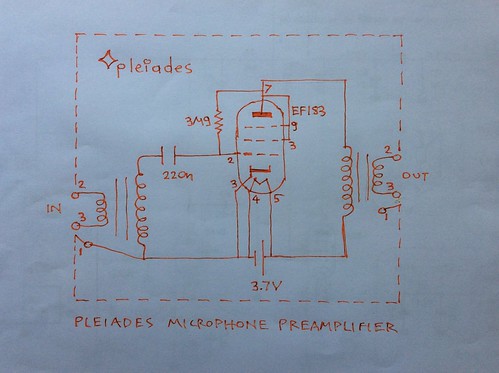
Playing with the above Pleiades V6 schematic.
Cc is 22nF. Rag Pleiades bias resitor is 1.8MΩ for less than 2 volts at the anode. A 10Ω resistor is between 3.7V and heaters for further underheating.
Signal path, setup:
Male singing voice at 8in to 2in - Shure Unidyne III - Pleiades V6 with Altec 4722 input transformer - Sony TC-D5 Pro (XLR mic in at mono mode) - Sennheiser HD580
A discharging capacitor of 220μF supplied the anode from 4V to less than 0.5V. It takes about 2 minutes and listening for gradual sound quality variations can be heard in real time while singing.
Operation at 1.3V for the EF183 is as easy as a walk in the park. Impressive sound.
It seems even easier for the EF183 or at least as easy operating with an ultra small anode voltage as it is for the Nuvistor 7586. The anode current is always higher on thenEF183 for the same conditions.
At 4V mic distance had to be about 7in. At Va=1.3V the mic distance had to be 2in-3in for natural bass unheavy sound.
Gain becomes low at 500mV. At less than 1.3V the sound starts to change quickly. This is for a 1.8Ω Pleiades bias resistor. Perhaps lower anode potentials can be optimized by a smaller Rag resistor.
Would it be possible to power the 4BC8 variμ with just a 1.5V battery including both heater and anode supoly?
Further reading:
The Pleiads Bias
Operating features of the Audion - E. h. Armstrong
On preserving the transconductance of electron tubes at anode potential as low as 3V
Flat frequency response from producer's brain to listener's brain, Sound Picture Recording and Reproducing Characteristics - D. P. Lowe, K. F. Morgan - JSMPE

No comments:
Post a Comment